It’s Earth Day once again, but after the flood of anti-climate policy changes enacted by the current administration since January 2025, it’s a miracle the holiday is still federally recognized. On his first day of office, Trump revoked a number of past presidential executive orders facilitating the protection of hundreds of miles of ocean land from oil drilling, plans for mitigating climate change impacts on land and public health, and the prioritization of clean energy solutions. He then issued two additional executive orders, entitled “Unleashing American Energy” and “Declaring a National Energy Emergency,” which collectively prioritize the extraction of as many resources as possible from federal lands and waters, even if it requires using “emergency authorities” to do so. These include seeking exemptions to the Endangered Species Act and expediting the approval of energy projects under the Clean Water and National Environmental Policy Acts. Despite production being at an all-time high, Trump’s justification for these orders is that the United States’ energy supply is “far too inadequate,” though he did not feel the need to pursue the potential of wind or solar.
While they may garner a lot of attention, executive orders do not have the power to simply undo everything. That requires changing laws, a power that is shared and checked by all three branches of the government. Rather, executive orders require the federal government to reprioritize their policies while still following the law. For example, agencies may open investigations into related activities to determine their compliance; update government websites (like the removal of key climate change information from USDA.gov); and revise regulations according to the order (which can then be challenged in court and already are). This process can take months to years, but this is not to say that executive orders have no immediate effects: they are a direct message to the American People. Trump’s executive orders use inflammatory wording such as “climate extremism” (#14148), descriptions of climate policies as “burdensome and ideologically motivated” (#14154), and false information that the policies have “exploded inflation and overburdened businesses” (#14148) and “limited the generation of reliable and affordable electricity, reduced job creation, and inflicted high energy costs upon our citizens” (#14154). These messages are received by millions of Americans and, with the president’s true motives obscured, are accepted as reality. Trump has no problem lying to his very loyal followers that the real reason he wants to expand oil drilling is so that he can profit from his thousands of contracts with oil companies and their sponsors, not to “lower prices” for hard working Americans.
Enter: The Climate Denialism Movement. One particular use of campaign dollars, donations, and oil company profits earned off the backs of hard-working Americans is to fund conservative thinktanks, whose mission is to mislead. They frame climate policy as “anti-American,” “anti-Christian,” and “pro-socialism” and back up their claims with biased and distorted “research” that favors the motives of their sponsors. Just a few weeks ago, the climate-denial thinktank The Heartland Institute held an “International Conference on Climate Change” in Washington D.C. that featured the administrator of the EPA, Lee Zeldin, as a keynote speaker. Throughout the keynote, “the truth” was consistently advocated for by all three of its speakers, but never actually uttered. It opened with James Taylor, the president of the Heartland Institute, who praised the thinktank’s progress since it began during Al-Gore’s presidency. “We decided to fight for the truth,” he declared to a cheering crowd, “and the truth is clear: There is no climate crisis. The science is very clear.” He immediately followed up this promise for truth by the claim that “restoring CO₂ to the atmosphere is not something to fight or to apologize for. It’s something to celebrate and promote.” According to him, “plant life” is suffering from a lack of CO₂ just as mountain hikers may suffer from inadequate oxygen. In other words, the Heartland Institute has moved beyond plain denial of climate change to touting that its negative impacts are actually positive–more accurately described as climate delusionism than denialism.
Following up Taylor’s speech was Craig Rucker, president of CFACT (Committee for a Constructive Tomorrow), a non-profit only in name with a very similar mission to the Heartland Institute. He introduced Zeldin by a long list of his EPA policy reforms following Trump’s orders, praising him for “cutting waste and refocusing the agency” to deal with “actual pollution, clean air [and] clean water instead of race-based or socioeconomic priorities.” This is again far from the truth, as among the reforms are the deregulation of power plant rules, blurred lines of what can be considered protected waters of the United States (WOTUS), and streamlining of the permit process for energy projects, all of which negatively impact “actual pollution, clean air [and] clean water.”
Finally, Lee Zeldin took the stage. Praising himself to the audience, he claimed that if Trump had not won the election, a different EPA administrator would be following “Bernie Sanders and Ed Markey and all of their friends” with “blind obedience.” “Shame on me for not having blind obedience,” Zeldin touted sarcastically, as if he himself were not backed by the founder of a billion-dollar fracking company, Tim Dunn, who has also donated millions to Donald Trump’s campaign. Unsurprisingly, the Heartland Institute and CFACT are funded by oil companies. If catering to every will of billion-dollar companies is not blind obedience, it’s difficult to say what is. Zeldin continued his speech in a haphazard fashion, at times going on for minutes on a claim that environmental activist organizations use all of their donations to simply train more activists, or how the uncertainty of weather predictions should mean no one prediction on climate change can be trusted. Still, Zeldin cycles back to the common message the conference desperately wanted to put across: “This group operates and must always–the EPA as well–operate under truth and transparency. Honesty is something the American Public values.”
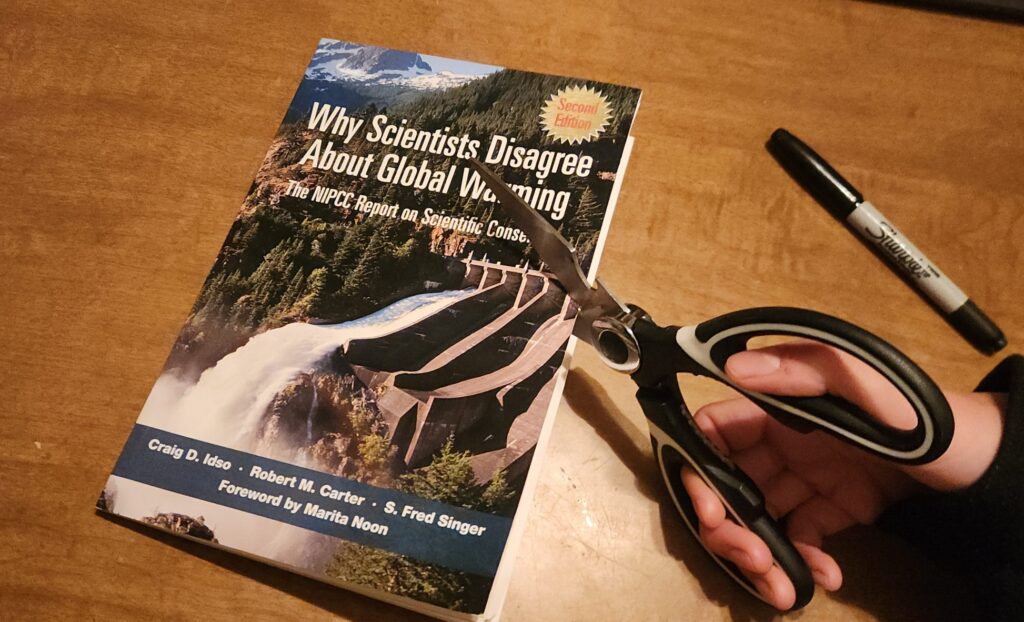
Despite this hailing of “truth,” The Heartland Institute has a history of spreading misinformation in order to promote anti-climate policy. In 2017, they sent out 25,000 copies of their “textbook” entitled “Why Scientists Disagree About Global Warming” to science teachers around the U.S., touting more of the same “research” that this month’s conference-goers were exposed to. This was followed by a similar mailing of a different book in 2023. In 2012, they notoriously compared those who believe in global warming to the Unabomber in a billboard campaign, a choice that actually caused them to lose several of their sponsors. And now, on the eve of the country’s 250th anniversary, they are helping ensure that the United States falls far behind other world leaders in its ability to resist climate change. Despite their actions that say otherwise, The Heartland Institute still pretends to be concerned about the environment, but with “a free market approach to energy and environmental policies” according to their website, which is rather the antithesis to environmental protection. It’s not a coincidence that this conference occurs just a few weeks before Earth Day each year–and for all the wrong reasons.
Trump, Zeldin, fossil fuel companies, and anti-climate organizations have no remorse over lying to the public because they know that the true power lies in the hands of voters, and to get voters to vote against their best interests, they need them to believe that climate policy is their enemy. No wonder oil companies spend billions on lobbying and advertising to help keep up the facade–it’s a lot of evidence to cover up. That the U.S. government permits this intentional deception of the public is reprehensible. Free speech is not the same as using lies to take away another’s freedom to make informed decisions. It has led to a nation of people who feel unsure of who to trust, overwhelmed, and helpless, like there’s some secret being kept from them about how the world actually works. If you can’t trust the scientists, world leaders, and the news, who are you supposed to trust? In response, some cling even more to their fears: that their neighbors are against them, that their beliefs are being persecuted. Our polarization prevents us from having productive conversations, a division that only makes it easier for climate denial campaigns. While I would love for someone to read this article and be changed from climate-denier to climate-activist, the truth is they wouldn’t get past the headline.
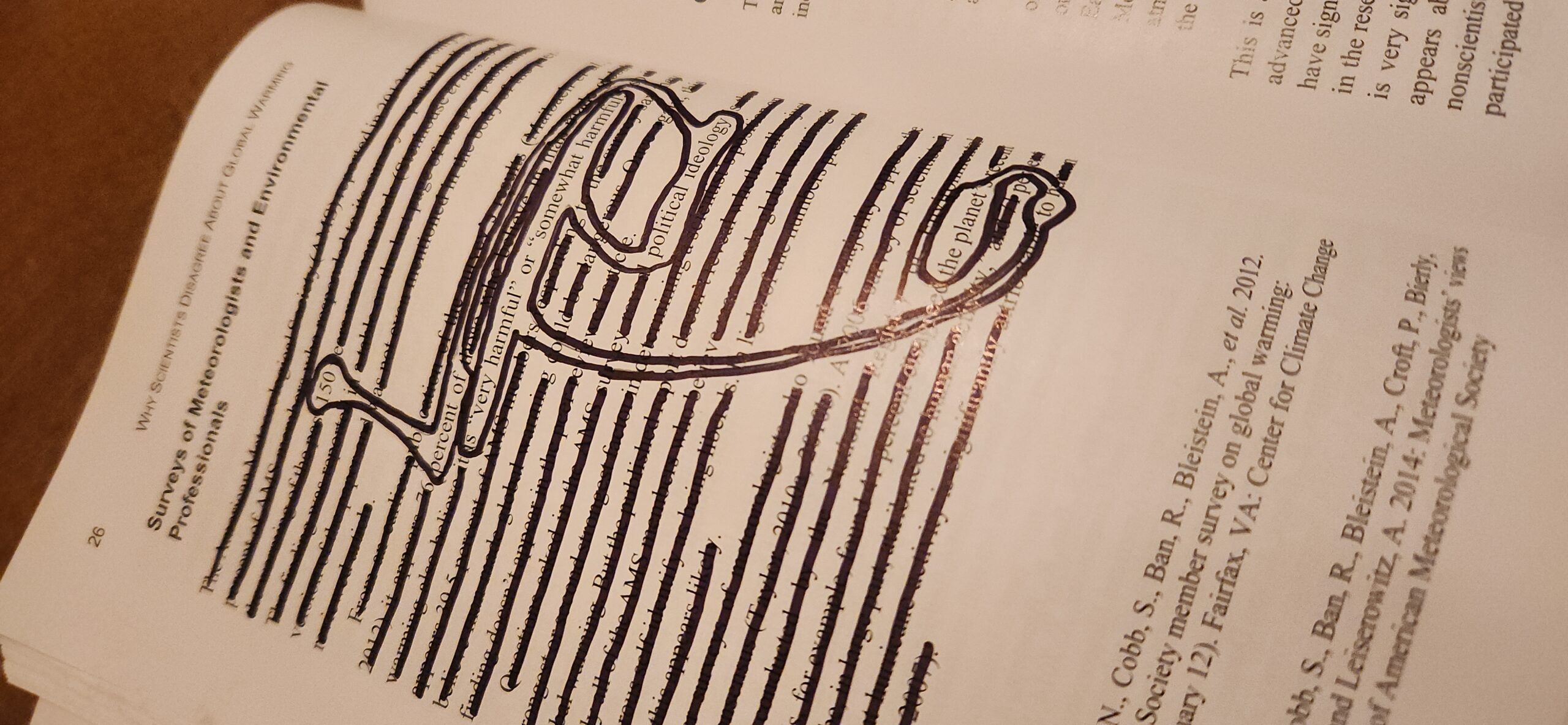
Climate-denialism is erasing the truth, and I have a problem with that. I intend to reveal the actual truth, one way or another, and while I don’t have billions of dollars to spend on an actual truth campaign to start these conversations, I do have a copy of The Heartland Institute’s “textbook,” a marker, and a pair of scissors. By warping their warped words, slicing through their sliver of reality, art is its own form of protest. Erasure poetry, the act of blacking out words to highlight others and reveal a new message, is a literal uncovering of the poet’s truth. Call it wasteful, but really, it’s restoration. There’s something revolutionary about physically destroying something that is meant to harm. This book is propaganda, and has poisoned minds, like so many of our waterways, lands, and bodies. So, as far as what you and I can actually do: have conversations with neighbors, think about where your food comes from and where your trash ends up, make radical art, and don’t be silent. The earth needs you to.